Live Chat, WhatsApp, or Instagram? How Customers Actually Want to Message You


Your customers are ready to message you. The question isn’t whether they will, but where. In 2024, 61% of customers prefer contacting brands through digital channels, and that number keeps growing. But not all channels are created equal. Some customers love the immediacy of live chat. Others want WhatsApp’s familiarity. Still more expect to reach you on Instagram. The real opportunity? Offering all of them, and letting your customers choose.
Key Takeaways: Learn which messaging channels your customers actually prefer, why multiple channels matter more than picking one, and how to build a strategy that serves both your team and your customers effectively.
TL;DR: 79% of businesses report live chat improves sales and revenue, while 52% of customers stay loyal to brands offering it. SMS achieves a 98% open rate and 81% of users check texts within 5 minutes. The winning strategy isn’t choosing one channel, it’s orchestrating multiple ones together to match customer habits and preferences.
Key Customer Messaging Statistics
- Digital Channel Preference: 61% of customers prefer contacting brands via digital channels, up from 45% in 2023 (Source: Verint)
- Live Chat Loyalty Impact: 52% of customers are more likely to stay loyal to companies offering live chat, and 79% of businesses report improved sales and revenue after implementing it (Source: Kayako)
- SMS Open Rate: SMS messages have a 98% open rate, far surpassing email’s 20%, with 81% of consumers checking texts within 5 minutes (Source: Sender and Simple Texting)
- Real-Time Support Impact: 72% of U.S. consumers say real-time text support improves customer service experiences (Source: Giva)
- Investment in Channels: 40% of businesses plan to invest in live chat in 2025, 29% in SMS, and 27% in in-app messaging (Source: Nextiva)
- RCS Adoption Readiness: RCS device coverage has reached 96%, with 59% of businesses planning RCS deployment (Source: Bandwidth)
Why Customers Want Different Channels
Customers don’t have a one-size-fits-all preference. They choose channels based on context, urgency, and habit. WhatsApp feels personal because it’s where they message friends. Instagram feels native because they already spend time scrolling. Live chat feels immediate because they see a human (or at least a proxy for one) waiting to respond. The truth is simple: customers want to reach you where they already are, not where you want them to be.
Live chat leads because it combines speed with human presence. A chatter is 2.8 times more likely to convert than a regular visitor, and those who do convert spend 60% more on average. Live chat creates urgency. It removes friction. It answers the question before doubt sets in.
SMS, meanwhile, is the overlooked powerhouse. With 90% of messages read within three minutes and 77% getting a response within 10 minutes, SMS is where time-sensitive messages land. It’s not for casual chat. It’s for order updates, appointment reminders, and exclusive offers. SMS is the channel your customers check before anything else.
Live Chat, WhatsApp, and Instagram: When to Use Each
Live chat is best for immediate sales support and website visitors with active questions. A customer browsing your product pages at 2 AM deserves an answer now, not tomorrow. Live chat delivers that. It’s your conversion machine.
WhatsApp is best for building ongoing relationships and post-purchase support. It feels less corporate, more personal. Customers who already trust you appreciate a message on WhatsApp because it reaches them in a space they control. RCS messaging, a richer version of SMS, bridges the gap by adding images and buttons while maintaining SMS’s speed and reach.
Instagram and social messaging work best for brand discovery and complaint resolution. Customers often search for you on social before buying. They also post complaints publicly, expecting public responses. Being there matters for reputation and conversion.
The Real Power: Orchestrating Channels Together
Picking one channel is the mistake. The data is clear: customers using multiple channels during their journey convert 43% higher, but only when experiences are orchestrated, not fragmented. Orchestration means your customer’s conversation history follows them. If they start on Instagram, switch to WhatsApp, then email, each agent has the full context. That seamless handoff is what builds loyalty.
Start with live chat on your website. It’s the gateway. Add SMS for transactional updates and time-sensitive offers. Layer WhatsApp for relationship-building. Include Instagram and other social channels for discovery and reputation management. Most importantly, ensure they all connect to the same customer record. One conversation, multiple channels.
Building Your Messaging Strategy in 2026
Begin by asking: Where are your customers already? If your audience is Gen Z, Instagram matters. If they’re busy professionals, SMS and WhatsApp dominate. If they’re on your website considering purchase, live chat is non-negotiable. Your strategy should match your customers’ habits, not industry trends.
Track response times and conversion by channel. Live chat should respond within seconds. SMS within minutes. WhatsApp and Instagram within hours. Each channel has speed expectations baked in. Meet them, or lose the sale.
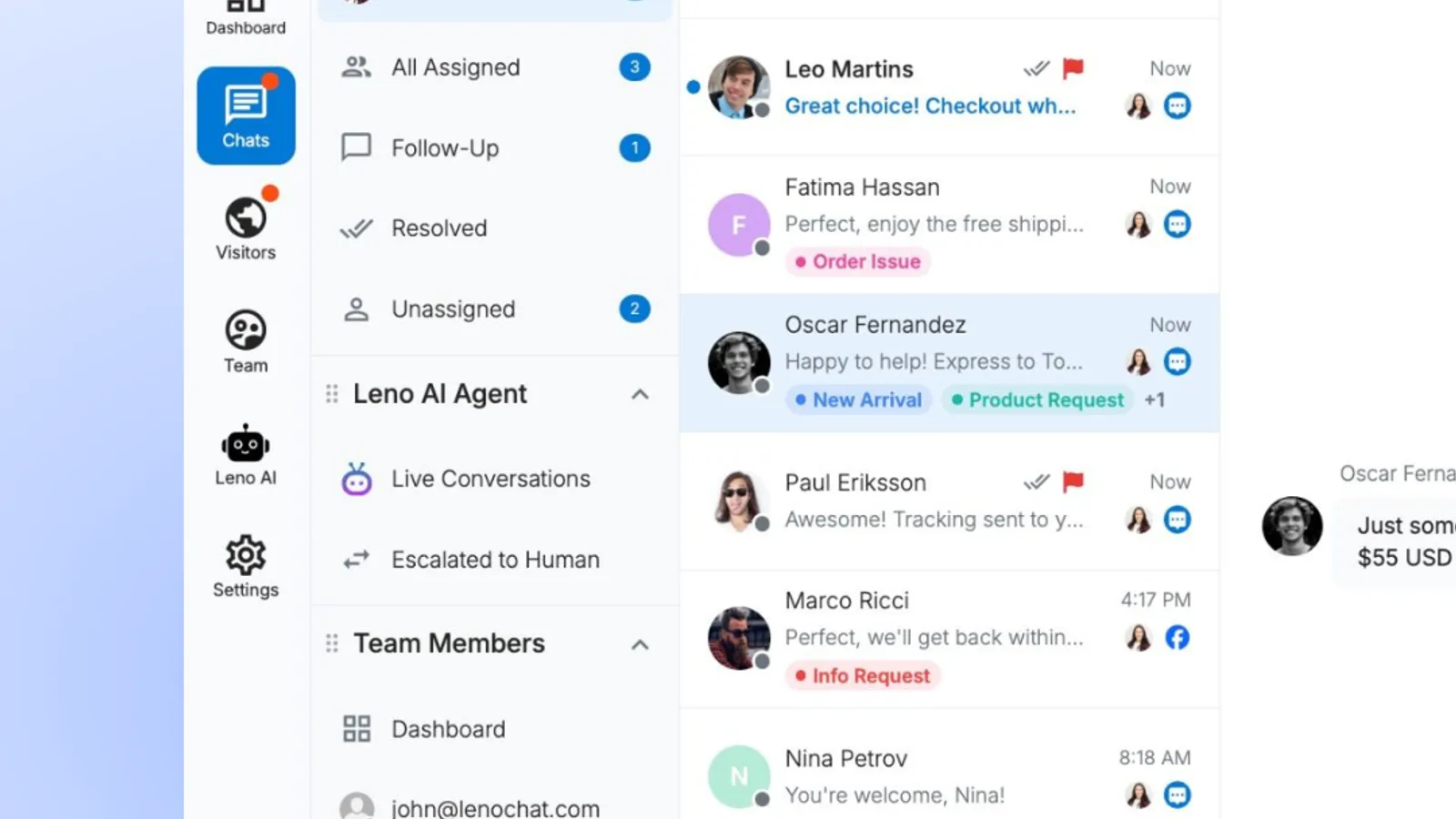
Most critically, invest in integration. Separate tools for each channel waste time and lose context. Best for e-commerce stores running on Shopify or WooCommerce: unified platforms like LenoChat that consolidate live chat, SMS, WhatsApp, and Instagram into one inbox. Your team stays focused. Your customers stay happy. Your data stays clean.
Common Questions About Messaging Channels
Which channel gets the fastest response times?
SMS and live chat compete for speed. SMS achieves 90% read rate within 3 minutes and 77% of messages get responses within 10 minutes. Live chat averages response times in seconds for available agents. For absolute urgency, live chat wins. For guaranteed delivery and read confirmation, SMS wins.
Should we remove phone support if we add messaging?
No. Phone support remains critical for complex issues and elderly customers. Messaging handles routine inquiries faster and cheaper, freeing your team for calls that truly need human voice. The hybrid approach converts more and satisfies more customers.
How do we avoid message overload across channels?
Unified inbox software is essential. Route incoming messages from all channels into one queue. Let agents filter by channel, customer segment, or priority. Smart routing prevents chaos and ensures consistency.
Your customers already know which channel they prefer. They’re already waiting for you there. The question isn’t whether to add messaging channels. It’s how fast you can orchestrate them all at once. Start with live chat and SMS, add WhatsApp and Instagram, and watch your conversion and loyalty both climb.
Related Articles
 Marketing
AI chatbot limitations for questions that need a person

AI chatbot limitations matter most when one wrong answer can cost money, expose an account or put someone at risk. In a 2026 global survey, Gartner found 87% of customers wanted access to a person when companies used generative AI. Start with these six handoffs. A bot is better suited to repeat policy lookups than […]
 Marketing
How to train new support agents for chat in their first week

You can train new support agents to answer simple chats alone by the end of their first week. That week matters: about 70% of contact center agents who quit in year one leave within 90 days, a 2024 COPC report found. Here’s the plan, day by day. Those figures come from large contact centers. In […]
 Marketing
Shipping delay message templates for late, lost and sold-out orders
A shipping delay message works best when it arrives before the customer asks. In a 2025 Sendcloud survey of UK shoppers, 85.4% said they expect to hear immediately when an order runs late. Here are ready-to-paste messages for late, lost, sold-out and partly shipped orders. What does every shipping delay message need to include? Every […]
 Marketing
Facebook Messenger for business without missed leads
On this page How fast should you reply to a Facebook message? Where should your Facebook messages go? Which Messenger questions should you cover with quick replies? What should happen to messages that arrive after hours? How do you stop Messenger leads from being forgotten? Facebook Messenger for business works best when every message has […]
 Marketing
Chat lead generation without a long form
You can improve chat lead generation without turning the conversation into a form. Sleeknote found that one-field forms converted at 4.41% across more than 329 million popup impressions. Start with one easy detail, earn the next, and pass the full conversation to sales. 1. How can you ask for one detail first? Photo: Jonas Leupe […]
 Marketing
Proactive chat messages that help visitors instead of interrupting them
A proactive chat message, sent before the visitor types anything, can save a sale or lose one. In Baymard Institute’s survey of US shoppers, 40% of those who abandoned checkout blamed extra costs like shipping, a question one well-timed message answers. Here’s when to speak first, and what to say. Every template below uses {curly} […]