How to train new support agents for chat in their first week
To train new support agents for chat, move them from reading to watching to drafting replies over five days, and they can answer simple chats alone by Friday.

Key takeaways
- About 70% of contact center agents who quit in year one leave within 90 days.
- Teach the most common questions, their saved replies and the refund policy before any live chat.
- Spend about three days shadowing: one watching you, then two drafting replies you approve.
- Let new agents reply alone first on simple topics such as order status, then add one topic at a time.
- Review closed chats daily and hold a short check-in instead of watching new agents live.
You can train new support agents to answer simple chats alone by the end of their first week. That week matters: about 70% of contact center agents who quit in year one leave within 90 days, a 2024 COPC report found. Here’s the plan, day by day.
Those figures come from large contact centers. In a team of two or three, losing one hire hurts more, because the owner goes straight back to answering every chat.
What should a new support hire learn before their first chat?
They should learn the questions customers ask most often, the saved replies that answer them, and the policies behind those replies, in that order.

Start Monday by pulling up last month’s chats and sorting them into topics together. The biggest piles become the week’s curriculum. Everything else can wait until week two.
Saved replies, also called canned responses, are pre-written answers an agent pastes into a chat and then personalizes. Ask your new hire to read each one next to a real chat where it was used, so they see how much editing a good reply needs. If you don’t have a set yet, these canned responses for live chat support give you a base to adapt.
Then cover the policies: refunds, returns, shipping cutoffs, discounts and what an agent is allowed to promise. Write the limits down plainly, including who approves a refund outside the window. Returns deserve extra time, because they’re the chats where a wrong answer loses a customer, so walk through how to handle a return request chat together.
Don’t make Monday all reading. Contact Center Pipeline cautions that a first week built mostly from heavy compliance modules, with one trainer as the only person to ask, falls short, because new hires need direct access to their manager early. It also suggests pairing every new agent with a buddy from day one for quick questions. In a small team, that buddy is usually you, so expect to be interrupted.
How long should a new agent shadow real chats?
Plan on about three days: one watching you reply, then two drafting replies that you approve before they’re sent.
That sits at the short end of the 3 to 10 business days of shadowing before a first solo contact, according to outsourcing firm Stealth Agents, which cites Gartner’s 2025 Customer Service Survey. A small business with a narrow set of questions can stay at the short end.
Shadowing means the new hire watches an experienced person handle live chats. On Tuesday, have them sit beside you or watch your shared screen while you answer. Say out loud why you picked each saved reply, when you rewrote it, and when you decided a chat needed someone else. That reasoning is the part they can’t get from reading.

On Wednesday and Thursday, swap roles. In reverse shadowing, the new agent writes every reply and you read it before it goes out. They practice the real skill, and you catch mistakes before a customer sees them.
Don’t stretch the watching phase. Contact Center Pipeline describes a new agent who shadowed a veteran too early and got too little hands-on practice. It recommends about three short practice sessions a week in the first month, built around the team’s most common failure points and talked through afterward with a coach or buddy.
See how LenoChat handles this for small teams.
When can a new agent reply to customers alone?
They can reply alone once their drafts need almost no edits, starting with one or two simple question types such as order status or shipping times.

Friday can be a realistic first solo day on those topics. Keep refunds, complaints and anything involving money with you for now, and tell the new agent that’s the plan, not a verdict on their work. Add one topic at a time over the following weeks.
Full proficiency takes much longer than a week. ICMI’s 2025 benchmark, as cited by Stealth Agents, puts it at 4 to 12 weeks for simple tier-1 support roles and 6 to 8 months for complex queues. Contact centers bridge that gap with nesting, a period of 2 to 4 weeks where new agents handle live contacts under supervision.
Measure the right things during that stretch. COPC recommends judging new agents first on whether they retain what they learned and follow the process, then adding quality and speed targets as they develop. Tell your hire up front that the targets will change, so a slow first week doesn’t feel like failure.
If a chatbot answers first on your site, show the new agent what a conversation looks like when the bot passes it over, so they know how a chatbot human handoff should go from the receiving end.
How do you check a new agent’s chat quality without hovering?
Read their closed chats at the end of each day instead of watching them live, and save your feedback for one short, scheduled conversation.
Regular feedback keeps people as well as standards. In a 2024 report, COPC found that 73% of contact center staff who get regular, structured feedback are satisfied, compared with 49% of those who don’t.
Pick five chats a day. For each one, note one thing that worked and one specific change, written as the exact sentence you’d use instead. A vague note about sounding warmer won’t change the next reply. A rewritten sentence will.
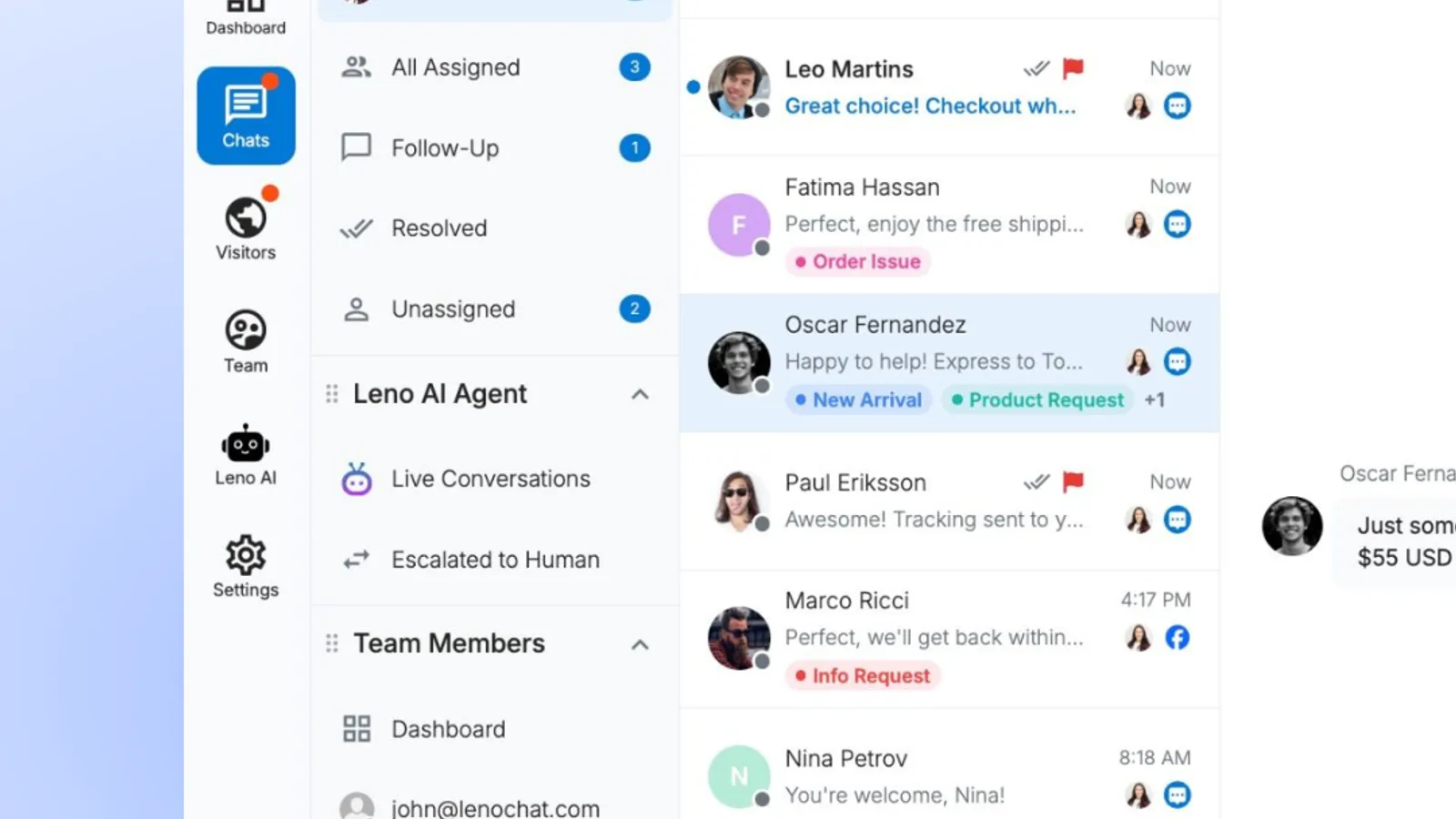
Your chat tool should make the review quick. In LenoChat, for example, the inbox has an All Resolved filter that works as a searchable archive of closed conversations, and you can leave internal notes on a chat that the team sees and the customer doesn’t. You can read the day’s chats in the evening and leave each comment right where it happened.

Then talk. Contact Center Pipeline recommends a weekly check-in of 15 minutes about wins and blockers, plus coaching time in the schedule and feedback on both accuracy and empathy. In the first week, hold a short version every day. After that, weekly is enough, and you can move to the live chat metrics your whole team is measured on.
This structure costs you less time than improvising. Managers spend 8 to 12 hours per new support agent over the first 90 days with structured onboarding, compared with 25 to 40 hours when onboarding is informal, according to Gartner figures cited by Stealth Agents.
What does the whole first week look like?
It moves from reading to watching to drafting to replying alone, one step a day.
- Monday: sort last month’s chats by topic, read the saved replies, and learn the key policies.
- Tuesday: watch you answer live chats while you explain each choice.
- Wednesday: draft every reply for you to approve before it’s sent.
- Thursday: keep drafting, and run a practice session on the topic they missed most.
- Friday: answer simple question types alone, then review the day’s chats together.
This plan is best for teams of two or three where the owner still answers chats and can’t sit beside a new hire all day. Keep week two similar and add one topic at a time. Once the simple questions are theirs, your own evenings start to come back.
Ready to answer every customer from one place? Start free with LenoChat.
Frequently asked questions
What should you send a new support hire before their first day?
Send a realistic preview of the job: screenshots of the tools they'll use, a sample recorded customer conversation and a short work exercise. Contact Center Pipeline recommends this so new hires know what the work involves before they start.
Does giving a new support agent a buddy help them stay?
It's linked to better retention. SHRM onboarding research from 2024, as cited by Stealth Agents, ties assigning a buddy or mentor to 36% lower attrition in the first 90 days. In a small team, the buddy is often the owner.
Why do new support agents quit in the first months?
Weak training is a common factor. COPC reported in 2024 that only 71% of contact center staff felt their training prepared them to succeed, and staff satisfied with their training are twice as likely to stay at least a year.
Does a support team lead need to know the tools well?
Yes. COPC reported in 2024 that staff who see their leader as technically competent are three times more satisfied and twice as likely to stay another year. About one in four say their leader lacks the technical skills to help them.
Sources
Image credits
Related Articles
 Marketing
AI chatbot limitations for questions that need a person

AI chatbot limitations matter most when one wrong answer can cost money, expose an account or put someone at risk. In a 2026 global survey, Gartner found 87% of customers wanted access to a person when companies used generative AI. Start with these six handoffs. A bot is better suited to repeat policy lookups than […]
 Marketing
Shipping delay message templates for late, lost and sold-out orders
A shipping delay message works best when it arrives before the customer asks. In a 2025 Sendcloud survey of UK shoppers, 85.4% said they expect to hear immediately when an order runs late. Here are ready-to-paste messages for late, lost, sold-out and partly shipped orders. What does every shipping delay message need to include? Every […]
 Marketing
Facebook Messenger for business without missed leads
On this page How fast should you reply to a Facebook message? Where should your Facebook messages go? Which Messenger questions should you cover with quick replies? What should happen to messages that arrive after hours? How do you stop Messenger leads from being forgotten? Facebook Messenger for business works best when every message has […]
 Marketing
Chat lead generation without a long form

You can improve chat lead generation without turning the conversation into a form. Sleeknote found that one-field forms converted at 4.41% across more than 329 million popup impressions. Start with one easy detail, earn the next, and pass the full conversation to sales. 1. How can you ask for one detail first? Photo: Jonas Leupe […]
 Marketing
Proactive chat messages that help visitors instead of interrupting them
A proactive chat message, sent before the visitor types anything, can save a sale or lose one. In Baymard Institute’s survey of US shoppers, 40% of those who abandoned checkout blamed extra costs like shipping, a question one well-timed message answers. Here’s when to speak first, and what to say. Every template below uses {curly} […]
 Marketing
How to handle a return request chat and keep the customer
A return request chat can save the next sale if you settle the facts before debating the refund. In a 2025 US survey, the National Retail Federation and Happy Returns found that 71% of consumers were less likely to buy again after a poor returns experience. Use this four-part flow to protect the customer relationship. […]