How to handle a return request chat and keep the customer
A return request chat goes better when you collect the facts first, automate policy answers and reserve exceptions for a person.

Key takeaways
- Ask for the order, item, return reason, condition and preferred outcome before promising a refund.
- Automate policy lookups, but send damaged items and exceptions to a person.
- 71% of US consumers are less likely to shop again after a poor returns experience.
- A refusal should explain the policy, acknowledge the problem and offer the next available option.
A return request chat can save the next sale if you settle the facts before debating the refund. In a 2025 US survey, the National Retail Federation and Happy Returns found that 71% of consumers were less likely to buy again after a poor returns experience. Use this four-part flow to protect the customer relationship.
What should you ask before approving a return?
Ask for the order, item, return reason, item condition and preferred outcome before you promise a refund or exchange.

Start with information your team needs for every return. Ask for the order number and email address, then confirm which item the customer wants to send back. If you use a Shopify chat connection, keep the order record beside the conversation so the customer doesn’t have to repeat details already attached to the purchase.
Next, ask why the item is coming back and whether it has been opened, worn, assembled or damaged. The answer matters because your policy may treat a wrong size differently from accidental damage or a change of mind.
A 2025 Shorr Packaging survey of US consumers found that 44% cited the wrong size, 31% cited damage, 11% said the product didn’t match its description and 9% had simply changed their mind. Give agents a short intake list that covers those common paths:
- Order number and purchasing email
- Item name and quantity
- Reason for the return
- Current condition and packaging
- Photos when damage or a mismatch is reported
- Preferred result, such as a refund, exchange or replacement
Don’t ask the customer to prove everything before you acknowledge the problem. Confirm that you’ve understood the request, then explain why you need each missing detail. This keeps the exchange from sounding like an interrogation.
Which return questions can a chatbot answer?
A chatbot should answer policy lookups and process questions, while a person should decide exceptions and disputed facts.

Good automated questions have one answer in the current return policy: whether an item category is eligible, where to send it, what condition it must be in and which documents to include. The bot can also collect the intake details before handing the conversation to your team.
Build the answer from the policy itself, not from a loose prompt. A practical chatbot knowledge base should contain the public policy plus direct question-and-answer entries for wording customers actually use, such as asking whether a sale item can be returned.
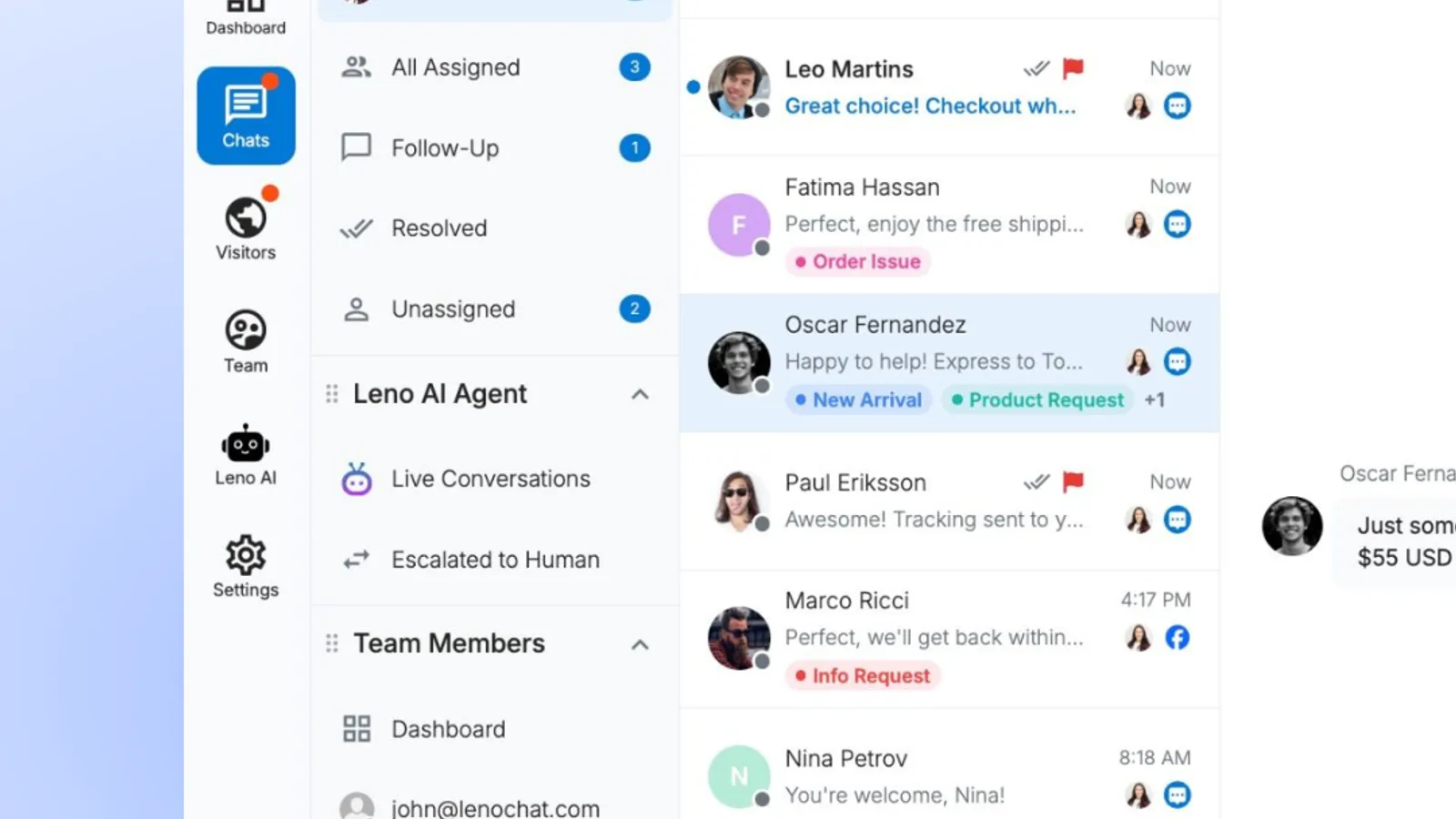
In LenoChat, you can add a return policy as a public webpage or a written question-and-answer entry. LenoAI uses that material for its response and can pass the conversation to a person when it can’t find a confident answer.
A policy chatbot is better suited to repeat eligibility questions, while a person is better suited to damaged orders, conflicting evidence and requests outside the stated rules.
Best for: Stores whose chat queue repeats policy questions but still needs a person to approve exceptions.
Don’t let the bot invent an approval date, refund amount or exception. It should say what the policy covers, collect the facts and clearly state when a person will review the request.
See how LenoChat handles this for small teams.
When should a person take over?
A person should take over when the customer reports damage, disputes the policy, requests an exception or shows clear frustration.

Damaged, missing and incorrectly described items need judgment because the facts may change what you owe and what remedy makes sense. A person can inspect photos, compare the complaint with the order and decide whether to replace the item, refund it or request more evidence.
Give the customer a visible route out of automation. In a global Gartner survey reported by DestinationCRM in 2026, 87% of customers said companies using generative AI for service must provide access to a human agent.
The handoff should carry the order details, return reason and previous messages into the agent queue. A good chatbot handoff prevents the customer from starting again and tells them what happens next.
Set clear triggers for human review:
- The customer says the item arrived damaged or unsafe.
- The item doesn’t match its description.
- The order falls outside the standard return window.
- The customer disputes a restocking or shipping charge.
- The account shows repeated or conflicting return claims.
- The customer asks for a person or becomes upset.
Fraud checks still matter, but don’t treat every request as suspicious. The National Retail Federation and Happy Returns reported that 9% of US retail returns were fraudulent. Review unusual patterns privately and keep the customer-facing message focused on the information needed to decide this return.
How do you refuse or delay a refund without losing the customer?
State the decision plainly, give the policy reason and offer the closest available remedy or a firm update date.

Start with the customer’s specific situation. Then explain the rule in one sentence. Avoid hiding the decision beneath several paragraphs of policy language.
For a refusal: I checked order {order number}. This item isn’t eligible for a refund because {plain-language policy reason}. I can still offer {available option}, and I can arrange that here if you’d like.
If the refund is allowed but delayed, separate approval from payment timing. Tell the customer whether you’ve received the return, whether you’ve approved it and when they should expect the next update.
For a delay: We’ve received your return for order {order number}, and the refund is now {current status}. You can expect {next action} by {date}. If that doesn’t happen, reply here and we’ll check it for you.
Don’t push store credit as though it were the same as cash. A 2025 Shorr Packaging survey found that 75% of US consumers preferred a full refund over store credit. Offer credit as an alternative only when the customer can still choose the refund your policy promises.
Speed also affects whether the customer returns. About 92% of US consumers said they would shop with a retailer again after a faster refund, while 44% would rather visit a dentist than wait 7 days, according to TodayPay research reported by Retail Customer Experience in 2026.
If you can issue an exchange or refund immediately, say so early. The National Retail Federation and Happy Returns found that 76% of US consumers were more likely to choose a return option offering an instant refund or exchange.
Start this week by giving your team one intake list, one policy source and one handoff rule. Those three pieces keep routine chats short while leaving room for a person to handle the cases that shape whether the customer buys again.
Ready to answer every customer from one place? Start free with LenoChat.
Frequently asked questions
Should you offer store credit instead of a refund?
Offer it as a choice, not the only option when your policy allows a cash refund. Most surveyed US consumers prefer a full refund.
Do customers expect free return shipping?
Many do. In a 2025 US survey by Shorr Packaging, 86% wanted free return shipping, so disclose any return postage charge before purchase.
How long should an ecommerce return window be?
US consumers in a 2025 Shorr Packaging survey preferred 30 days. Your actual window should match your products, costs and local consumer law.
What should a chatbot do when a customer asks for a person?
Stop the automated exchange, preserve the conversation and transfer the request with the order details already collected.
Sources
Image credits
Related Articles
 Marketing
AI chatbot limitations for questions that need a person
AI chatbot limitations matter most when one wrong answer can cost money, expose an account or put someone at risk. In a 2026 global survey, Gartner found 87% of customers wanted access to a person when companies used generative AI. Start with these six handoffs. A bot is better suited to repeat policy lookups than […]
 Marketing
How to train new support agents for chat in their first week

You can train new support agents to answer simple chats alone by the end of their first week. That week matters: about 70% of contact center agents who quit in year one leave within 90 days, a 2024 COPC report found. Here’s the plan, day by day. Those figures come from large contact centers. In […]
 Marketing
Shipping delay message templates for late, lost and sold-out orders
A shipping delay message works best when it arrives before the customer asks. In a 2025 Sendcloud survey of UK shoppers, 85.4% said they expect to hear immediately when an order runs late. Here are ready-to-paste messages for late, lost, sold-out and partly shipped orders. What does every shipping delay message need to include? Every […]
 Marketing
Facebook Messenger for business without missed leads
On this page How fast should you reply to a Facebook message? Where should your Facebook messages go? Which Messenger questions should you cover with quick replies? What should happen to messages that arrive after hours? How do you stop Messenger leads from being forgotten? Facebook Messenger for business works best when every message has […]
 Marketing
Chat lead generation without a long form

You can improve chat lead generation without turning the conversation into a form. Sleeknote found that one-field forms converted at 4.41% across more than 329 million popup impressions. Start with one easy detail, earn the next, and pass the full conversation to sales. 1. How can you ask for one detail first? Photo: Jonas Leupe […]
 Marketing
Proactive chat messages that help visitors instead of interrupting them
A proactive chat message, sent before the visitor types anything, can save a sale or lose one. In Baymard Institute’s survey of US shoppers, 40% of those who abandoned checkout blamed extra costs like shipping, a question one well-timed message answers. Here’s when to speak first, and what to say. Every template below uses {curly} […]