User Management
April 15, 2026
Invite team members, assign Owner, Admin, or Agent roles, and manage who has access to your LenoChat workspace.
How User Management Works in LenoChat
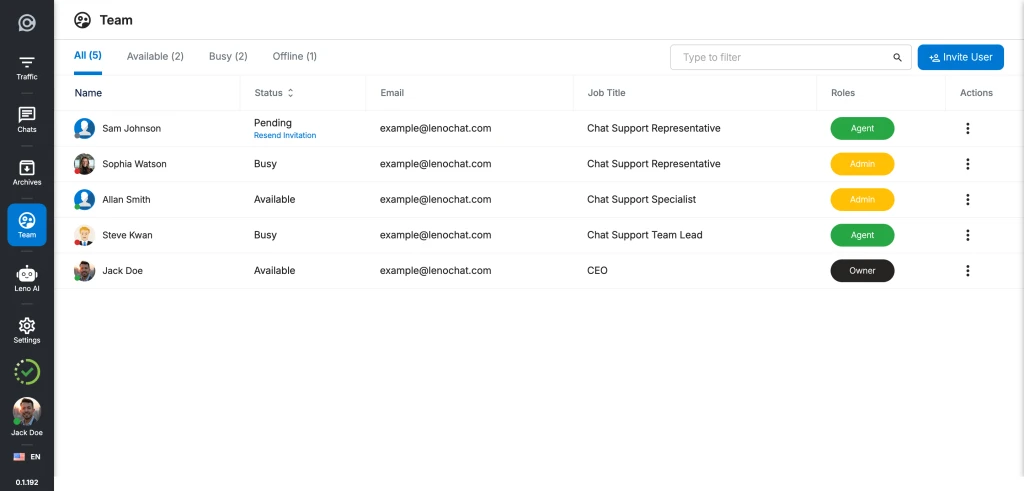
Every LenoChat workspace has a single team roster, accessible from Team Settings in the main navigation. The roster lists all current members with their name, job title, role, and online status. From this view, workspace Owners and Admins can invite new members, change existing roles, update profile details, and permanently remove users. Agents can view the roster but cannot perform any management actions. All management actions are enforced on both the client and the server — hiding the controls from Agents is backed by server-side permission checks, so bypassing the UI is not possible.
- Invite new team members by email — they receive an activation link valid for 24 hours.
- Assign each member one of three roles: Owner, Admin, or Agent.
- Edit a member's display name and job title without changing their login credentials.
- Remove members permanently from your workspace — their login is immediately revoked.
- Transfer workspace ownership to another team member when needed.
- Monitor team availability with live status indicators — Available, Busy, or Offline.
The Three Roles Explained
LenoChat uses three roles to control what each team member can see and do across the workspace. Every workspace has exactly one Owner and can have any number of Admins and Agents within the limits of your current plan. Roles are not cosmetic labels — they determine which UI controls are rendered, which API actions are permitted, and which settings pages are accessible.
- Owner — has full, unrestricted access to the entire workspace. The Owner can invite users, change any role, edit any profile, delete any member (except themselves), and is the only person who can transfer workspace ownership to someone else. There is exactly one Owner per workspace at any time.
- Admin — can do almost everything an Owner can do, with two key exceptions: Admins cannot manage other Admins or the Owner, and they cannot transfer workspace ownership. Admins can invite Agents and other Admins, change the role of an Agent, and delete Agents.
- Agent — the standard support role. Agents handle conversations in the inbox and can view the team roster to see who is available, but they have no team management capabilities. They cannot invite users, change roles, edit other members' details, or delete anyone.
Role Permissions at a Glance
The table below summarises exactly what each role can do in the Team Settings area. All rows reflect enforced permissions — actions marked No are blocked at both the UI and API level.
| Action | Owner | Admin | Agent |
|---|---|---|---|
| View team roster | Yes | Yes | Yes |
| Invite new team members | Yes | Yes | No |
| Invite as Admin | Yes | Yes | No |
| Invite as Owner | No — use ownership transfer | No | No |
| Change Agent's role | Yes | Yes | No |
| Change Admin's role | Yes | No | No |
| Change Owner's role | No | No | No |
| Edit any member's name and job title | Yes | Agents only | No |
| Delete an Agent | Yes | Yes | No |
| Delete an Admin | Yes | No | No |
| Delete the Owner | No | No | No |
| Transfer workspace ownership | Yes | No | No |
How to Invite a New Team Member
Inviting a new team member sends them an email with a unique activation link. The link is valid for 24 hours. Until the recipient clicks the link and activates their account, they appear in the team roster with a pending status. You can resend the invitation at any time before the link expires.
- Step 1: Navigate to Team Settings from the dashboard sidebar. The Team Members table lists all current members.
- Step 2: Click the Invite User button in the top-right corner of the table. A side panel opens with the invitation form.
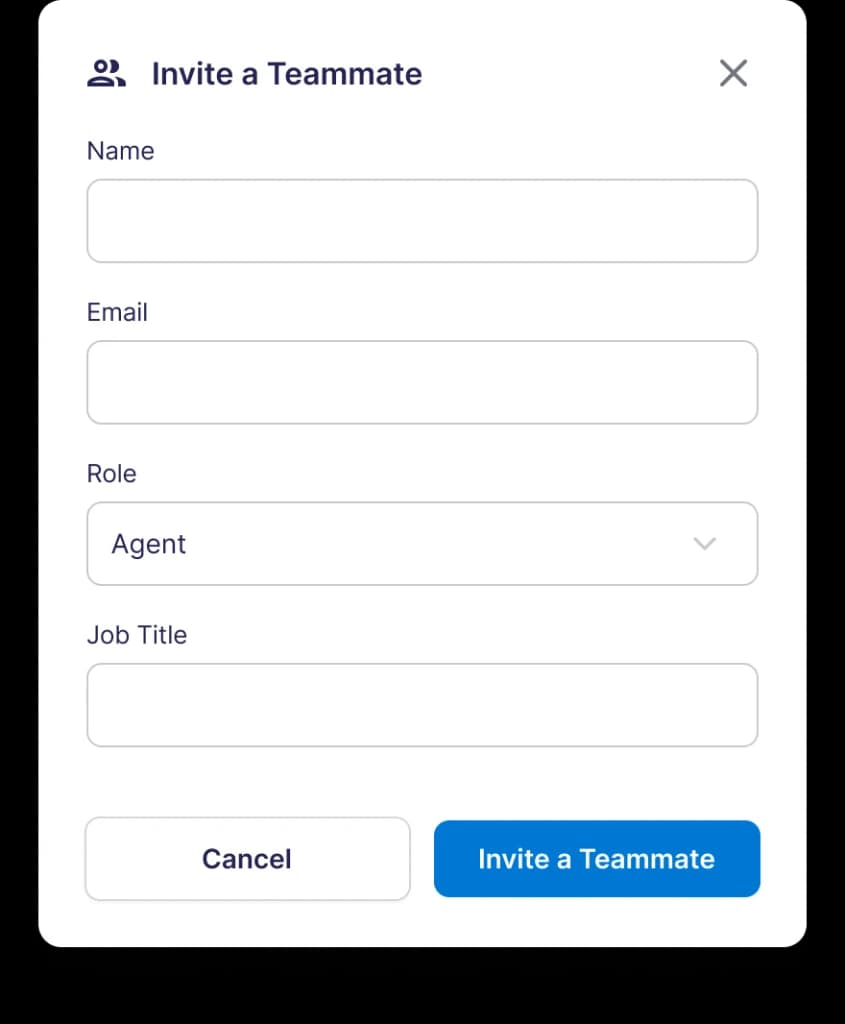
- Step 3: Fill in all four required fields — Name (the team member's full name), Email (their work email address), Role (choose Agent or Admin), and Job Title (their position, for example 'Support Agent' or 'Sales Lead').
- Step 4: Click Invite User to send the invitation. LenoChat validates the email — if the address already belongs to an active member, you will see a 'User already exists' error and the invitation will not be sent.
- Step 5: The recipient receives an invitation email from support@lenochat.com with a personalised activation link. They click the link, set their own password, and are added to your team roster as an active member.
What Happens After the Invitation is Sent
Once you click Invite User, LenoChat generates a unique 10-character invitation code, stores a 24-hour expiry timestamp against it, and dispatches a personalised email. The process is fully automated — no manual follow-up is needed unless the recipient does not receive the email or the link expires before they activate their account.
- The invitation code is single-use and tied to the invited email address. If the recipient tries to activate using a different email, the activation will fail.
- If 24 hours pass without activation, the link expires and the user cannot complete sign-up using that link. Use the Resend Invitation option in the team roster's action menu to generate a new code with a fresh 24-hour window.
- After activation, the new member appears in the team roster with their name, job title, role badge, and an Offline status indicator. Their first login is with the credentials they set during the activation flow.
- Pending (not yet activated) users are visible in the team roster so you know the invitation was sent. They cannot log in until they complete the activation step.
How to Change a Team Member's Role
Role changes take effect immediately — no logout or session restart is required. When you promote an Agent to Admin, they instantly gain access to team management features. When you demote an Admin to Agent, their management access is revoked straight away.
- Step 1: Locate the team member in the Team Members table.
- Step 2: Click the three-dot actions menu at the right end of their row.
- Step 3: Select Change Role from the dropdown menu.
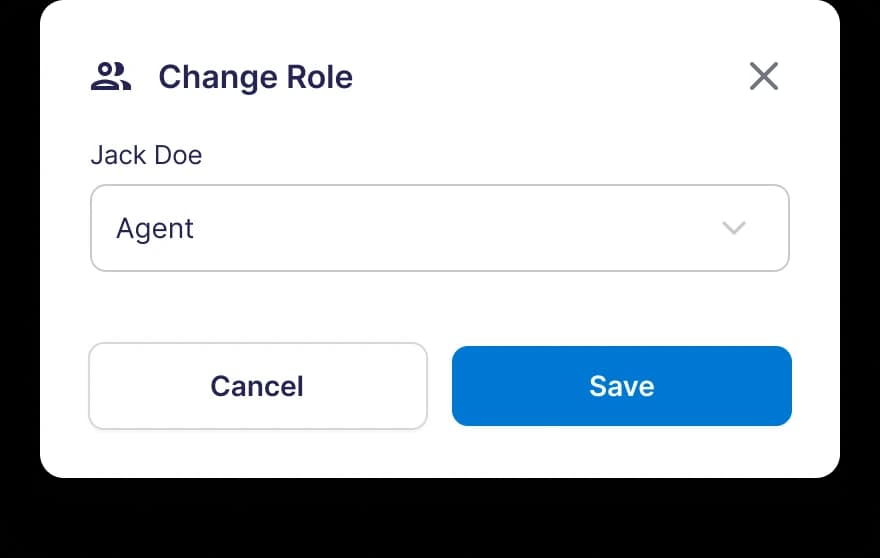
- Step 4: A dialog appears showing the member's current role. Select the new role — Agent or Admin — then click Change Role to confirm.
- The role badge on the team roster row updates immediately. The member's session is not interrupted — changes apply to any new actions they take from that point forward.
How to Edit a Team Member's Details
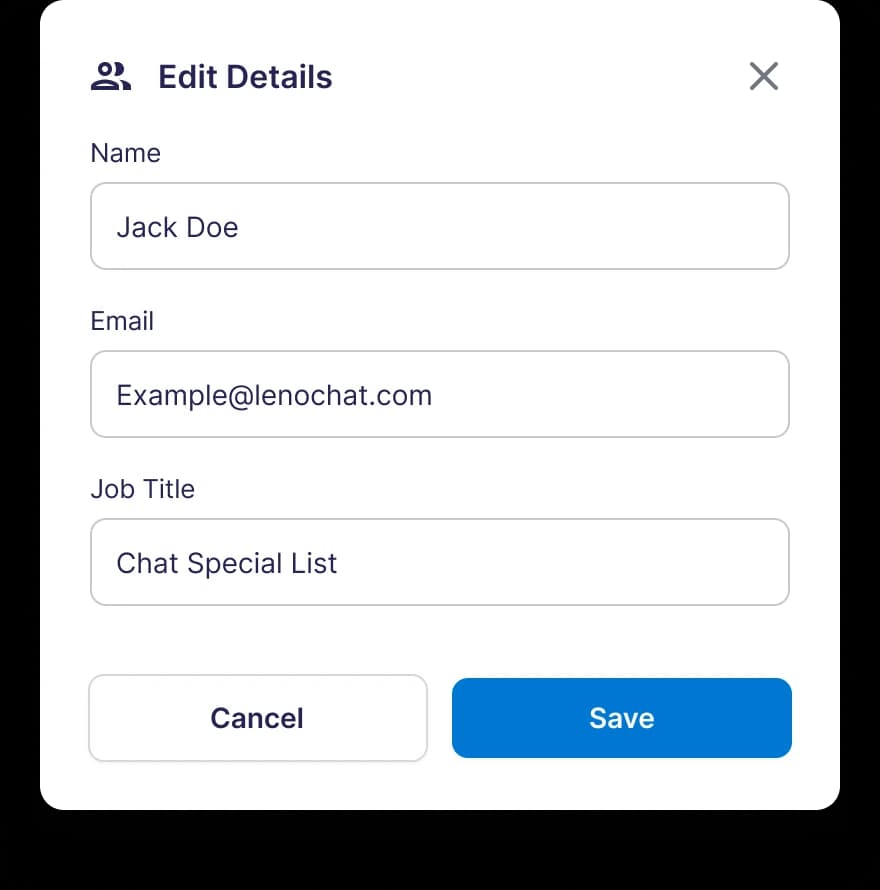
You can update a team member's display name and job title at any time. Email addresses are read-only after account creation and cannot be changed via the Team Settings panel — if a member needs a new email address, the current account must be deleted and a new invitation sent to the updated address.
- Step 1: Click the three-dot actions menu on the team member's row.
- Step 2: Select Edit Details from the dropdown.
- Step 3: Update the Name and/or Job Title fields. The Email field is greyed out and cannot be edited.
- Step 4: Click Save. The changes apply immediately and are reflected in the team roster and in the member's own profile.
How to Remove a Team Member
Removing a team member permanently deletes their account from your workspace. This action cannot be undone. The removed user immediately loses all access to the workspace and cannot log in. Any conversations previously assigned to them remain in the inbox and can be reassigned by an Owner or Admin.
- Step 1: Click the three-dot actions menu on the team member's row.
- Step 2: Select Delete User from the dropdown.
- Step 3: A confirmation dialog appears. This dialog cannot be dismissed by clicking outside of it — you must explicitly confirm or cancel the deletion.
- Step 4: Click Delete to confirm. The user is removed from the roster immediately and their login credentials are invalidated.
- Owners cannot delete themselves. Admins cannot delete other Admins or the Owner. Agents do not have access to the delete action.
How to Transfer Workspace Ownership
Workspace ownership can be transferred by the current Owner to any other active Admin or Agent. After the transfer, the current Owner becomes an Admin — they retain full access to the workspace but lose the exclusive Owner-only capabilities, such as the ability to transfer ownership again. The new Owner immediately gains all Owner privileges.
- Step 1: Click the three-dot actions menu on the target team member's row — the person who will become the new Owner.
- Step 2: Select Change Account Owner from the dropdown. This option is only visible to the current Owner.
- Step 3: Confirm the transfer in the dialog. The change is permanent and immediate — once confirmed, you become an Admin and the selected member becomes the new Owner.
Team Member Plan Limits
The number of team members you can add depends on your subscription plan. When you reach the limit for your plan, the Invite User button is disabled and a yellow upgrade banner appears at the top of the Team Members table. Upgrade to add more teammates.
| Plan | Maximum Team Members | Behaviour When Limit Reached |
|---|---|---|
| Free | 2 (you + 1 additional) | Invite User button disabled; yellow upgrade banner shown |
| Plus | 5 | Invite User button disabled; yellow upgrade banner shown |
| Pro | Unlimited | No limit — Invite User button always active |
The Team Members Dashboard
The Team Members Dashboard is available on Plus and Pro plans and gives Owners and Admins a real-time operational view of the entire team. It surfaces live availability data alongside conversation workload metrics so you can see at a glance who is available to take new chats, who is at capacity, and how conversations are distributed across the team.
- Available (green) — agents with their status set to Available are ready to accept new conversations.
- Busy (red) — agents who have marked themselves as Busy will not receive new automatic assignments until their status changes.
- Offline (grey) — agents who are not logged in or have closed the dashboard.
- Assigned Chats — the total number of open conversations currently assigned to each agent.
- Unread — the number of unread messages in each agent's assigned conversations, highlighted in red when greater than zero.